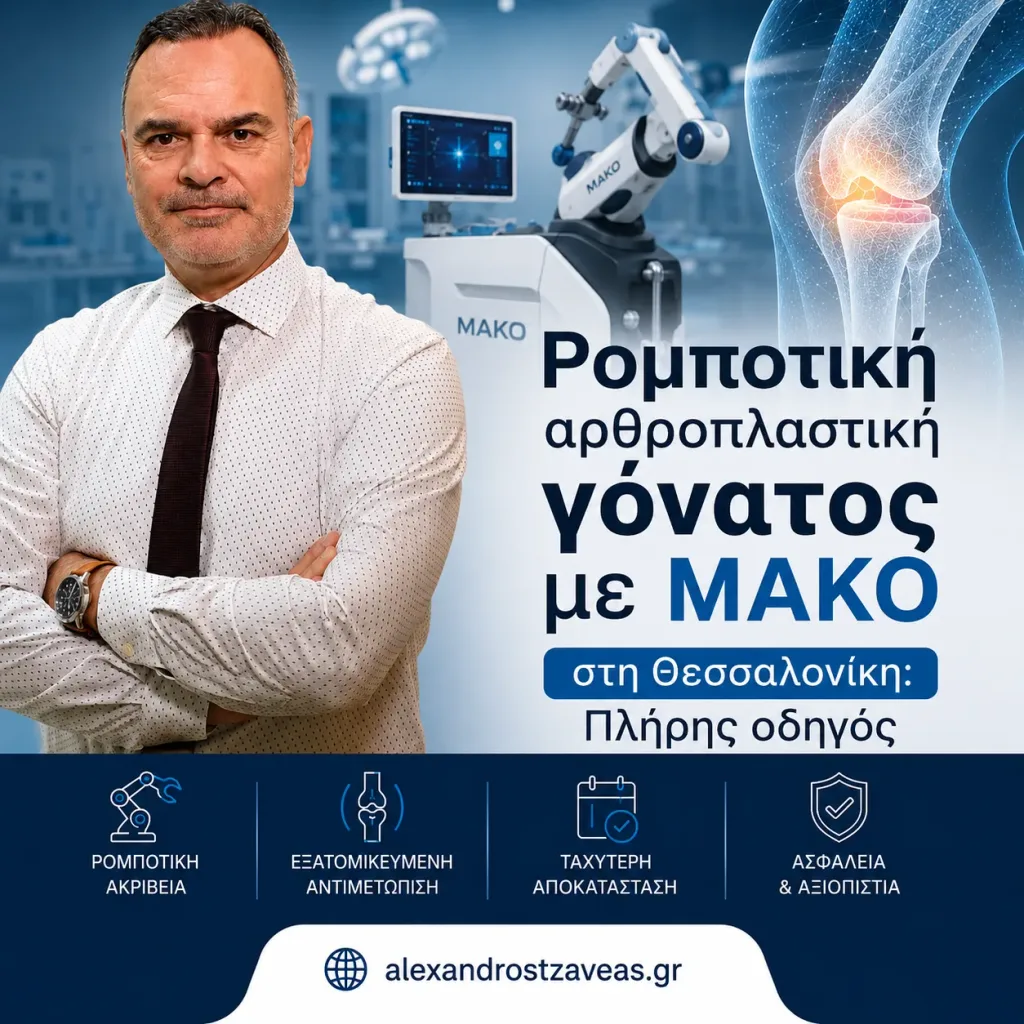

Robotic knee arthroplasty with MAKO in Thessaloniki is a modern option for patients with severe pain, stiffness and restricted movement caused by advanced wear in the knee. The method combines the experience of the orthopaedic surgeon with the ability of a robotically assisted system to provide more data, better preoperative and intraoperative planning and greater accuracy at critical stages of the operation.
The MAKO Knee System does not replace the surgeon and does not work on its own. The doctor remains responsible for every decision and every step of the operation. The system acts as an assistive tool, giving the surgeon information about the anatomy, the alignment, the movement and the balance of the knee, so that the positioning of the implants can be adapted as closely as possible to the needs of each patient. The MAKO Knee also supports the surgeon in total knee arthroplasty, helping with the bone cuts and with the assessment of the soft tissues during the operation. The aim of the operation is to reduce pain, to improve mobility and to return the patient to a more functional daily life. MAKO technology can contribute to more individualised planning, but the final result always depends on the correct indication, the experience of the surgical team, the patient's general health and a well-organised rehabilitation. The decision to proceed with robotic knee arthroplasty with MAKO is taken only after an individualised medical assessment by a specialist orthopaedic surgeon, based on the symptoms, the imaging studies, the level of function and the patient's realistic expectations.
What is robotic knee arthroplasty with MAKO?
Robotic knee arthroplasty with MAKO is a modern form of joint replacement in which the surgeon uses an advanced robotically assisted system to plan and to carry out critical steps of the operation with greater accuracy. In conventional knee arthroplasty the surgeon removes the worn surfaces of the joint and places specially designed implants, with the aim of restoring the function of the knee and reducing pain. In robotically assisted arthroplasty, MAKO adds a further level of planning and accuracy, helping the doctor to assess in greater detail the position of the implants, the alignment of the limb and the balance of the soft tissues. The most important thing for the patient to know is that MAKO does not “operate on its own”. It does not make decisions independently and it does not replace clinical judgement. Instead, it gives the surgeon real-time data, which are used together with the surgeon's experience and technique. Put simply, MAKO helps the surgeon to have better control over things such as:
The exact position of the implants
The alignment of the knee
The balance of the ligaments
Adapting the operation to the patient's anatomy
Carrying out the surgical plan more consistently
This technology does not change the basic aim of joint replacement, which is to relieve pain and to improve function. What it adds is the possibility of more individualised and more accurate planning.
How does the MAKO Knee System work?
The MAKO Knee System uses special sensors and tracking technology, so that the system knows precisely where the knee is in space during the operation. In this way it helps the surgeon to carry out the plan that has been designed for that particular patient. In practice, the process involves collecting information about the knee, assessing the wear and creating an individualised surgical plan. Depending on the protocol and on the case, the system may use preoperative or intraoperative data to help the surgeon adjust the bone cuts and the position of the implants. MAKO technology is particularly useful because every patient has a different anatomy. Two patients with osteoarthritis may have different deformity, different wear, different stability and different needs. MAKO helps to map those differences accurately. This assistance may matter in areas such as:
Adapting the operation to the patient's anatomy
Assessing the balance of the knee in flexion and extension
More accurate execution of the preoperative plan
Reducing deviations from the intended position of the implants
A better understanding of the mechanical behaviour of the joint
Even so, the technology is a tool. On its own it does not guarantee a perfect result and it does not remove the need for sound clinical judgement, sound technique and sound rehabilitation.
When is robotic knee arthroplasty with MAKO recommended?
Robotic knee arthroplasty with MAKO is considered when wear of the joint causes severe pain, stiffness and a real limitation of daily life. It usually concerns patients with advanced osteoarthritis in whom conservative treatments no longer provide satisfactory relief. Before surgery is discussed, options such as the following have usually been tried first:
Physiotherapy
Weight loss, where needed
Analgesic or anti-inflammatory medication, where this is permitted
Activity modification
Intra-articular treatments, where these are judged appropriate
Use of walking aids or changes to daily routine
When pain persists, however, when walking becomes difficult, when stairs cause considerable discomfort, when sleep is affected or when day-to-day independence is restricted, joint replacement may become a real solution. Age on its own is not an absolute criterion. What matters is the patient's general state of health, the level of activity, the severity of the symptoms, the condition of the joint and the patient's needs. One patient may have marked wear on radiographs but relatively mild symptoms, while another may have less advanced imaging findings but severe functional limitation. The decision is taken on the basis of the combination of:
Symptoms
Clinical examination
Radiographic findings
Functional limitation
Failure of conservative measures
Realistic expectations
MAKO robotic technology is not in itself an indication for surgery. In other words, nobody is operated on because a robotic system happens to be available. Surgery is carried out because there is a genuine medical indication for knee arthroplasty, and MAKO is used as a means of performing the operation more accurately and more individually.
What are the main indications?
The main indications for knee arthroplasty with MAKO robotic assistance mainly involve cases in which the joint has undergone significant wear and the patient's daily life is substantially affected. Common indications are:
Advanced osteoarthritis of the knee
Severe pain that does not settle with conservative treatment
Stiffness and restricted movement
Difficulty walking
Pain on stairs or when standing
Night pain
Deformity of the knee
Instability due to degenerative wear
Post-traumatic arthritis
In some patients the wear may involve the whole joint and require a total joint replacement. In other cases the damage may involve mainly one compartment of the knee, and it is then considered whether there is an indication for a partial joint replacement. The final choice depends on the clinical picture, on the radiographic assessment and on the overall condition of the joint. Robotic assistance can be particularly useful when greater accuracy in planning is required, when there is an anatomical peculiarity, or when the surgeon wants more detailed control of the alignment and balance of the knee.
What are the main contraindications or reasons for postponement
Not every patient is immediately suitable for knee arthroplasty. There are cases in which the operation must be postponed or avoided until specific risk factors have been dealt with. Common reasons for postponement or contraindication may be:
Active infection
Skin problems in the region of the knee
Poorly controlled diabetes mellitus
Serious cardiac or respiratory instability
A recent serious cardiovascular event
Serious clotting disorders
Inability to take part in rehabilitation
Very high surgical risk
Unrealistic expectations of the operation
Recent intra-articular injections into the knee
In many cases, being temporarily unsuitable does not mean that the patient can never have surgery. It may first be necessary to control blood sugar, to improve physical condition, to lose weight, to stop smoking, to treat dental or skin infections and to prepare more generally. The purpose of proper assessment is to reduce the risks and to increase the chance of a good result. The patient's safety matters more than the speed of the decision.
When is robotic knee arthroplasty with MAKO discussed?
Condition | Usual initial management | When is robotic knee arthroplasty with MAKO discussed? |
|---|---|---|
Mild osteoarthritis | Exercise, physiotherapy, analgesics and weight control | Usually not the first treatment option. |
Moderate wear | Conservative treatment and regular review | When pain persists and limits function despite conservative treatment. |
Advanced osteoarthritis | Individualised assessment by an orthopaedic surgeon | When there is severe pain and conservative treatment no longer provides adequate relief. |
Deformity of the knee | Clinical and radiographic assessment | When the deformity significantly affects walking and the stability of the knee. |
Marked stiffness | Physiotherapy where it can be of benefit | When stiffness and wear of the joint substantially limit daily life. |
How is the preoperative assessment carried out?
The preoperative assessment is one of the most important stages. It is not only about whether there is wear in the knee, but about whether the patient is genuinely suitable for surgery and which surgical plan best suits their case. The assessment begins with a detailed history. The doctor asks about:
When the pain began
Where it is felt
What makes it worse
Whether there is discomfort at night
How far walking is limited
Whether stairs are difficult
Whether there is a feeling of instability
Which treatments have already been tried
Which medicines the patient is taking
Which other medical conditions are present
A clinical examination then follows. The range of movement, the stability, the alignment of the lower limb, the muscle strength, the gait and the general function are all assessed. Imaging follows, usually with weight-bearing radiographs. These help to show the true state of the joint when the knee is taking weight. In particular cases further investigations may be requested, depending on the surgical plan. Robotic arthroplasty with MAKO also requires careful planning of the position of the implants and of the alignment of the knee. This planning is not done in a general or approximate way, but is tailored to the data of each individual patient.
How should the patient prepare before the operation?
Preparation before robotic knee arthroplasty with MAKO involves both medical and practical steps. On the medical side, the patient usually undergoes:
Blood tests
A cardiology assessment where needed
An anaesthetic assessment
A review of medication
Assessment of blood sugar and blood pressure
A check for possible sources of infection
Instructions about anticoagulant or antiplatelet medication
It is important that the patient tells the doctor about every medicine they take, including supplements and herbal preparations. Some medicines may need to be adjusted before the operation, but always under medical guidance. On the practical side, it is a good idea to organise the home for the first few days after discharge. This may include:
Removing rugs or obstacles
Arranging help from a relative
Preparing a comfortable place to rest
Suitable footwear
Arranging transport to and from the clinic
Advice on using a walking aid, if needed
Some patients may be advised to have physiotherapy before the operation. Strengthening beforehand can help with mobilisation afterwards. Good preparation reduces anxiety and helps the patient to take a more active part in their own rehabilitation.
The 3 main stages of the operation, step by step
Robotic knee arthroplasty with MAKO can be described in three main stages. In practice every case has its own particular features, but this structure helps the patient to understand the logic of the process.
Stage 1: Planning and mapping of the knee
The first stage is about precise planning. The surgeon assesses the anatomy of the knee, the extent of the wear, the alignment of the limb and the balance of the soft tissues. MAKO helps to collect and to use this information, so that an individualised plan can be created for the position of the implants. The aim is to take account of the real characteristics of that particular knee rather than to apply one general plan to everyone. At this stage the surgeon determines:
Where the implants will be placed
How the bone cuts will be made
How correct alignment will be achieved
How the balance of the joint will be maintained
How the operation will be adapted to that particular anatomy
This is one of the main advantages of robotic assistance: it gives the surgeon more information on which to base more accurate decisions.
Stage 2: Bone cuts and placement of the implants
In the second stage the necessary bone cuts are made and the knee is prepared for the implants to be fitted. MAKO acts as a guidance system. It helps the surgeon to stay within the planned procedure and to control the position and direction of the cuts precisely. The surgeon still performs the operation, but has data available that improve the accuracy of the process. During this stage the following are checked:
The position of the implants
The stability of the knee
Movement in flexion and extension
The balance of the ligaments
The fit of the trial components
If necessary, the surgeon can make adjustments before the final components are fitted. This matters because joint replacement is not only about replacing the worn joint, but also about the functional balance of the new knee.
Stage 3: Final check, wound closure and early mobilisation
In the third stage the joint is checked for the last time. The surgeon assesses the movement, the stability, the alignment and the overall behaviour of the knee. The wound is then closed and the patient is taken to the recovery room. From there the immediate postoperative care begins, which includes:
Pain control
Monitoring of vital signs
Prevention of thrombosis
Wound care
Gradual mobilisation
Instructions for the first hours and days
Early mobilisation is an important part of rehabilitation. Exactly when and how the patient first gets up depends on the protocol, on their general condition and on the instructions of the medical team. Standing, however, usually takes place on the same day as the operation.
Is robotic knee arthroplasty with MAKO safe?
Robotic knee arthroplasty with MAKO is generally considered safe when it is carried out in appropriately selected patients, by a specialist and trained surgical team, in a well-organised surgical environment. Like any operation, however, it carries possible risks. The possible complications of knee arthroplasty include infection, thrombosis, bleeding, stiffness, persistent pain, nerve or vascular injury and, more rarely, the need for further surgery. The NHS (the National Health Service of the United Kingdom) lists among the possible complications of knee replacement blood clots, wound infection, damage to nerves or tissue and problems with the new joint (nhs.uk). The presence of MAKO does not remove these risks. It can help with the accuracy of the planning and of the execution, but surgical safety rests on many factors:
Correct patient selection
Good preoperative preparation
An experienced surgical team
Adherence to protocols
Infection prevention
Antithrombotic treatment where indicated
Proper wound care
Well-organised rehabilitation
The World Health Organization has developed the Surgical Safety Checklist with the aim of reducing errors and adverse events and of improving communication within the surgical team. (World Health Organization) This philosophy shows that safety in the operating theatre is not a matter of technology alone, but of the organisation as a whole. The patient should also know which symptoms after surgery require immediate contact with the doctor, such as:
Fever
Marked redness around the wound
Discharge of fluid
Sudden swelling of the leg
Severe pain in the calf
Breathlessness
Pain that is getting worse rather than better
Contacting the medical team promptly is important for preventing and dealing with possible complications.
What are the realistic benefits of MAKO?
MAKO can offer significant advantages in surgical planning and technical accuracy, but it should be presented realistically. The possible benefits include:
Accurate planning of the operation
Better adaptation to the patient's anatomy
More data during the operation
More accurate placement of the implants
Better control of alignment
Assessment of soft-tissue balance
More predictable execution of the surgical plan
These benefits do not mean, however, that every patient will necessarily recover faster or better than anyone else. Recovery is influenced by many factors, such as:
Age
Weight
Muscle condition
Other medical conditions
The quality of the physiotherapy
How closely the instructions are followed
The condition of the knee before the operation
The correct way to put it is that MAKO helps the surgeon to achieve greater accuracy and individualisation, but does not “guarantee” a perfect result.
What should you expect from rehabilitation?
Rehabilitation after robotic knee arthroplasty with MAKO usually begins very early. In many cases the patient is mobilised on the same or the next day, always in accordance with the medical protocol and with their general condition. The first few days aim at:
Pain control
Getting out of bed safely
Walking with an aid where needed
Prevention of thrombosis
Control of swelling
Basic range-of-movement exercises
Wound care
The knee may be swollen, warm or stiff for the first few weeks. This does not necessarily mean a complication, but it should be monitored according to the doctor's instructions. Full recovery may take several months. The NHS states that recovery after knee replacement may take several months or longer, depending on the patient's age and general health. (nhs.uk) Physiotherapy plays a decisive role. It usually includes:
Range-of-movement exercises
Quadriceps strengthening
Gait re-education
Balance exercises
A gradual increase in activity
A functional return to daily life
Progress is not always linear. There may be days with better movement and days with more fatigue or stiffness. This is common and should not lead to discouragement, provided there are no worrying signs.
Practical advice for a better recovery
The success of rehabilitation depends to a large extent on the patient working together with the medical team and the physiotherapist. Useful practical advice is:
Follow the weight-bearing instructions closely
Do not increase your activity abruptly
Do the exercises exactly as you were shown
Do not skip your physiotherapy
Care for the wound as instructed
Keep an eye on the swelling and the pain
Take your medicines as prescribed
Avoid falls and sudden movements
Tell your doctor at once about any worrying symptoms
Rehabilitation should not be treated as a formality after surgery. It is a fundamental part of the treatment.
What results should you expect?
The main aim of robotic knee arthroplasty with MAKO is to reduce pain and to improve function. Many patients are able to return to everyday activities more comfortably, such as walking, stairs, driving, light exercise and social activities. The expected results may include:
Less pain
Better walking
Improved mobility
Greater stability
Better quality of sleep
Easier day-to-day function
It is important, however, to have realistic expectations. Joint replacement does not make the knee “new” in the absolute sense. It is an artificial joint, intended to improve function and to reduce pain, not to allow unlimited strain. Low-intensity activities such as walking, cycling, swimming and gentle exercise are usually more compatible with protecting the implant. High-impact activities, by contrast, may not be suitable for everyone.
Frequently asked questions
Does MAKO operate on its own?
No. MAKO does not operate on its own and does not replace the surgeon. The doctor performs the operation and makes all the decisions. The system provides data and technical assistance.
Is the operation safer because it is done with a robot?
Robotic assistance can help with accuracy, but safety depends on many factors: the correct indication, the surgeon's experience, protocols, preparation and rehabilitation.
Will I recover more quickly?
Not necessarily. Recovery depends on age, physical condition, other medical conditions, muscle strength and consistency with physiotherapy. MAKO helps mainly with the accuracy of the surgical planning and of its execution.
Does it hurt less because it is robotic arthroplasty?
Postoperative pain relates to the type of operation, to the individual response, to the pain relief given and to the rehabilitation. Robotic technology does not mean no pain at all.
Is it suitable for every patient?
No. Suitability is judged individually by the orthopaedic surgeon, on the basis of the condition of the joint, the symptoms, the general health and the expectations of the patient.
Is physiotherapy needed afterwards?
Yes. Physiotherapy is essential for regaining movement, for muscle strengthening and for a safe return to daily life.
How do you choose a doctor or a practice for robotic knee arthroplasty with MAKO?
The choice of doctor or practice should not be based on the presence of robotic equipment alone. The machine is an important tool, but its value depends on the person using it. Important criteria for choosing are:
The orthopaedic surgeon's experience in knee arthroplasty
Training in the use of MAKO
An understanding of the biomechanics of the knee
The ability to plan individually
Clear information given to the patient
Well-organised postoperative follow-up
Working together with physiotherapists
Availability for postoperative advice
An honest discussion of the benefits and the risks
The patient should feel that they understand why the operation is being recommended, exactly what will be done, what the realistic result is and what the possible risks are. Questions worth asking before the decision is made:
Why am I a suitable candidate for joint replacement?
How will MAKO help in my particular case?
Are there any alternative options?
What type of implant will be used?
How long will the rehabilitation take?
When will I walk?
When will I be able to drive?
Which symptoms after surgery should worry me?
What is the physiotherapy plan?
Being properly informed is a fundamental part of safety and of trust.
Conclusion
Robotic knee arthroplasty with MAKO in Thessaloniki is an advanced option for patients with severe wear in the knee, when pain, stiffness and restricted movement substantially affect daily life. The MAKO Knee System gives the surgeon more data, better control and greater accuracy in the planning and in the positioning of the implants. It does not, however, replace the doctor's experience, nor does it on its own guarantee a perfect result. Success rests on the right combination of technology, surgical experience, correct indication, well-organised rehabilitation and the active participation of the patient.
Next steps
If knee pain is limiting your walking, your sleep, your work or your day-to-day independence, the first step is a specialist orthopaedic assessment. Gather your investigations, note down your symptoms and tell the doctor about previous treatments and medicines. The final decision about robotic knee arthroplasty with MAKO should be taken after full information, an individualised assessment and a realistic discussion of the benefits, the risks and the rehabilitation.

