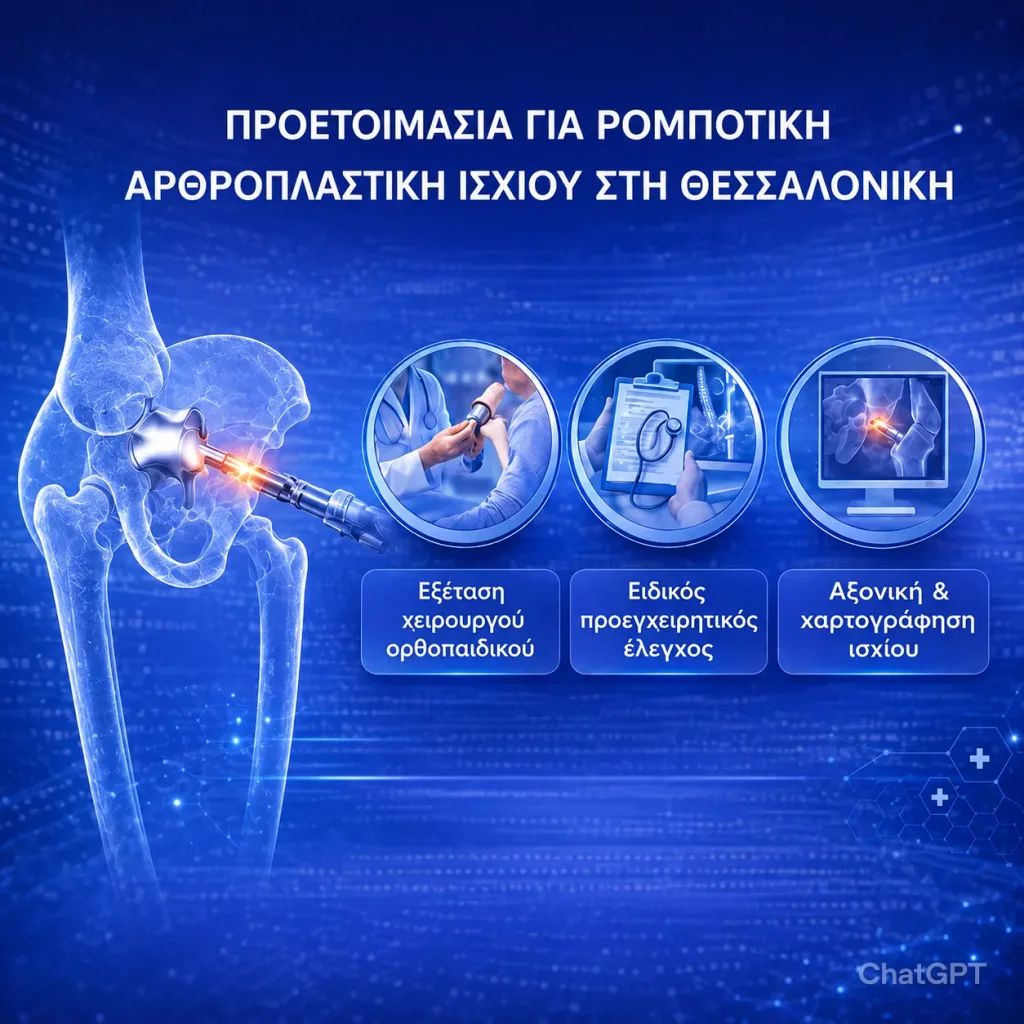

Preparing for MAKO robotic hip arthroplasty in Thessaloniki is an important stage for the safety of the operation and for a smooth postoperative recovery. This method is based on individualised three-dimensional planning and robotic assistance, so that the orthopaedic surgeon can plan the positioning of the implants precisely.
Proper preparation is not only about the tests before the operation. It includes fully informing the patient, adjusting their medication, assessing their general health, organising the home and understanding the first steps after the operation. The better prepared the patient is, the more calmly and methodically they can go into the surgical process.
Preparing for MAKO robotic hip arthroplasty: the initial orthopaedic assessment
The first step before MAKO robotic hip arthroplasty is a detailed orthopaedic assessment. The doctor examines the symptoms, how long the pain has lasted, difficulty in walking, restricted mobility and the way the condition affects the patient’s everyday life.
The decision to go ahead with hip arthroplasty is not based on the radiograph alone. The patient’s overall condition, the severity of the wear, the response to previous treatments and the expectations of the operation all need to be assessed. At this stage the patient has the opportunity to discuss all their questions with the orthopaedic surgeon and to be told whether the MAKO method is suitable for their particular case.
Imaging and MAKO three-dimensional planning
A key feature of MAKO robotic hip arthroplasty is its individualised three-dimensional planning. For this to be done, the patient undergoes special imaging, usually a computed tomography scan, so that a detailed digital model of the joint can be created.
On the basis of this model, the orthopaedic surgeon can study the anatomy of the hip, the site of the wear and the requirements for positioning the implants precisely. This planning helps the operation to be tailored to the data of that particular patient rather than to a general surgical template.
MAKO does not replace the surgeon. It works as an assistive tool, giving the doctor greater control and better guidance during the operation.
Preoperative tests and health assessment
Before the operation, the patient needs to complete the necessary preoperative assessment. This may include blood tests, a cardiological assessment, a chest radiograph, an electrocardiogram and an assessment by an anaesthetist.
This assessment is necessary to confirm that the patient can safely undergo the operation. Particular attention is paid to people with cardiac, respiratory, haematological or metabolic problems, such as diabetes mellitus or hypertension. If there are coexisting conditions, these may need to be brought under control before the operation is scheduled.
Adjusting medication before the operation
An important part of the preparation concerns medication. Patients must tell the doctor about all the medicines they take, including supplements and herbal preparations.
Particular care is needed with anticoagulants, antiplatelet drugs, anti-inflammatories and medicines that may affect blood clotting or the anaesthetic. The doctor and the anaesthetist will give clear instructions on which drugs are to be continued, which are to be stopped temporarily and when they should be stopped.
Patients must not change their medication themselves. Any change must be made only under medical guidance.
Preparing the body, and physiotherapy
Good physical condition before MAKO robotic hip arthroplasty can help with postoperative recovery. Where it is feasible, the doctor may recommend gentle strengthening exercises, improved mobility or preoperative physiotherapy.
Strengthening the muscles around the hip and better overall physical condition can make mobilisation after the operation easier. At the same time, if body weight is increased, the doctor may suggest specific advice for better control, since weight affects the load on the joint and the recovery.
Organising the home before going back
Preparation does not stop at the hospital. Patients also need to organise their own living space, so that returning home after the operation is safer and more comfortable.
It is useful to remove rugs, cables or objects that could cause a fall. Everyday items should be within easy reach. Temporary use of aids may also be needed, such as crutches, a raised toilet seat or a special chair, depending on the doctor’s instructions.
Having a relative or friend present for the first few days can help considerably, especially with moving about, personal care and following instructions.
The doctor’s role in the preparation
Proper preparation for MAKO robotic hip arthroplasty in Thessaloniki requires organised guidance from a specialist orthopaedic surgeon. It is the doctor who assesses whether the patient is suitable for the method, plans the operation, explains the stages and gives the necessary instructions before and after surgery.
Dr Tzaveas, with experience in modern arthroplasty techniques and in MAKO robotic assistance, can guide the patient from the initial assessment through to the preoperative planning and the recovery. An individualised approach helps the patient to know what to do, what to expect and how to prepare safely.
Conclusion
Preparing for MAKO robotic hip arthroplasty in Thessaloniki is decisive for a smooth course for the patient. It includes orthopaedic assessment, imaging, preoperative tests, adjustment of medication, physical preparation and organising the home.
With proper information, the orthopaedic surgeon’s experience and the patient’s active participation, the process becomes clearer, better organised and safer. MAKO technology offers precision and individualised planning, but success always rests on the right combination of medical experience, careful preparation and responsible postoperative follow-up.

