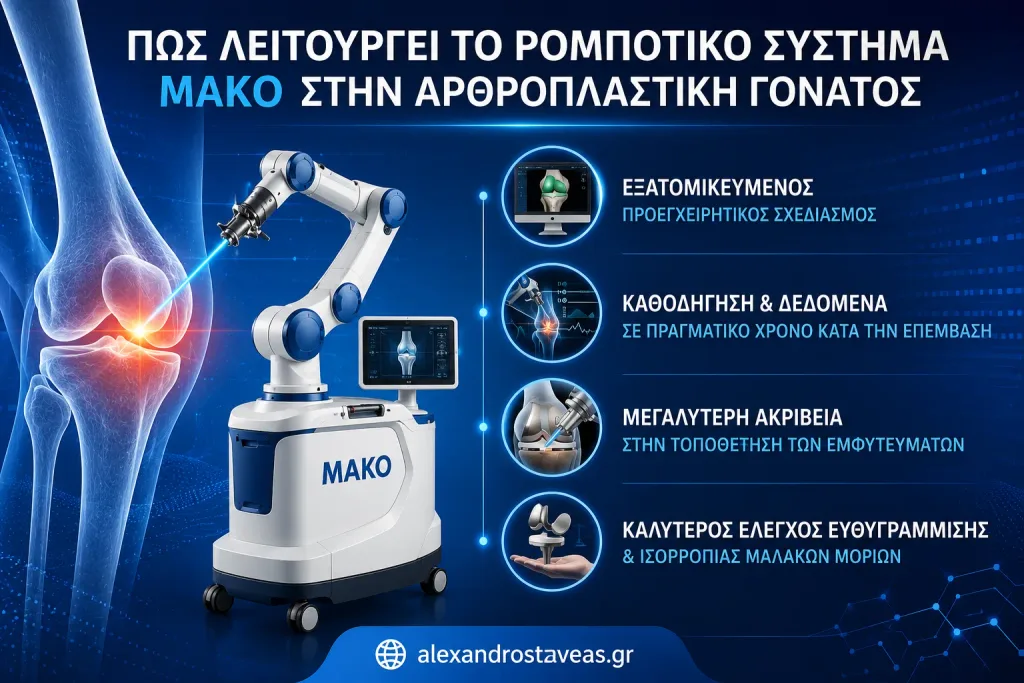

How does the MAKO robotic system work? The MAKO robotic system has been designed to offer greater precision and effectiveness in knee arthroplasty, allowing surgeons to adapt the procedure to the unique anatomical needs of each patient. Using advanced technology, MAKO supports the conduct of the operation, helping to ensure the best possible execution and the accurate positioning of the implants.
The MAKO robotic system is a modern robotic-assistance technology used in knee arthroplasty, with the aim of more accurate planning and better execution of the operation. Knee arthroplasty is an operation performed in patients with severe wear of the joint, marked pain, stiffness and restriction of everyday movement. MAKO does not replace the orthopaedic surgeon and does not perform the operation on its own. The surgeon always remains in full control. The system works as an advanced assistive tool that gives the surgeon more information about the patient's anatomy, the alignment of the knee and the exact position of the implants.
How the MAKO robotic system works in knee arthroplasty
MAKO is a robotically assisted system designed to help the orthopaedic surgeon in knee arthroplasty. Its basic function is to offer greater precision in the planning and positioning of the implants, taking into account the anatomical characteristics of each patient.
No two knees are the same. The wear, the alignment of the lower limb, the quality of the bone, the stability of the ligaments and the range of movement all differ from patient to patient. The MAKO system helps the surgeon to assess these factors and to adapt the operation to the real needs of the individual case.
How preoperative planning is carried out
Before the operation the orthopaedic surgeon assesses the condition of the knee by clinical examination and imaging. The degree of wear of the joint, any deformity, the stability of the knee and the patient's overall function are all examined.
A surgical plan is drawn up on the basis of these findings. MAKO helps in calculating more accurately the position of the implants and the alignment of the knee. This is particularly important, because correct positioning of the components can affect the stability, the movement and the long-term function of the joint.
Preoperative planning is not a formality. It is the stage at which the surgeon organises the operation around the individual patient rather than following a general approach applied to everyone.
What happens during the operation
During MAKO robotic knee arthroplasty the orthopaedic surgeon performs the operation, while the system provides guidance and data in real time. The surgeon can check the alignment, the balance of the soft tissues and the position of the implants with greater accuracy.
MAKO helps to ensure that the surgical steps follow the plan that has been drawn up. If an adjustment is needed during the operation, the surgeon can take account of the actual findings in the knee and make the necessary corrections.
This combination of human experience and technological assistance is the defining feature of the method. The technology offers precision and information, but clinical judgement and surgical experience remain decisive.
What are the main benefits of MAKO
One of the most significant benefits of the MAKO robotic system is greater precision in the positioning of the implants. In knee arthroplasty even small deviations can affect the way the knee feels, its stability and its function after the operation.
MAKO can help towards better control of the alignment of the lower limb and a better fit of the implant to the patient's anatomy. This can be particularly useful in patients with marked wear, varus or valgus deformity, or previous injuries.
In addition, a more precise surgical procedure can contribute to a more predictable outcome. This does not mean that every patient will have the same recovery or the same result, but that the surgeon has at his disposal an additional tool for a more controlled and more individualised operation.
Is MAKO suitable for every patient?
MAKO robotic knee arthroplasty is not necessarily the appropriate choice for every patient. Suitability depends on the severity of the wear, the symptoms, general health, age, coexisting conditions and the patient's expectations.
The orthopaedic surgeon considers whether the patient has advanced osteoarthritis, marked pain, restricted walking and a failure of conservative treatment. At the same time, he assesses whether there are factors that could increase the risk of the operation, such as active infection, serious uncontrolled medical conditions or an inability to take part in rehabilitation.
The choice of method must always be made on an individual basis and after a full medical assessment.
The role of the orthopaedic surgeon
Although MAKO offers significant technological advantages, the most decisive factor remains the orthopaedic surgeon. Correct diagnosis, the selection of the appropriate patient, careful surgical planning and postoperative follow-up have a direct bearing on the final result.
Dr Tzaveas, with experience in modern arthroplasty techniques and in robotic assistance, can assess every case individually and explain to the patient whether MAKO robotic knee arthroplasty is a suitable option. The technology is used as a tool for precision, while clinical experience remains at the centre of the treatment decision.
Conclusion
In knee arthroplasty the MAKO robotic system works as an advanced assistive tool that helps the orthopaedic surgeon to plan and carry out the operation with greater precision. It offers better information, more controlled positioning of the implants and the ability to adapt to the needs of each patient.
Success, however, does not depend on the technology alone. It depends on the correct selection of the patient, on the experience of the surgeon, on careful preparation and on an organised programme of rehabilitation. With the right guidance, MAKO can be an important tool for a more precise and more individualised knee arthroplasty.