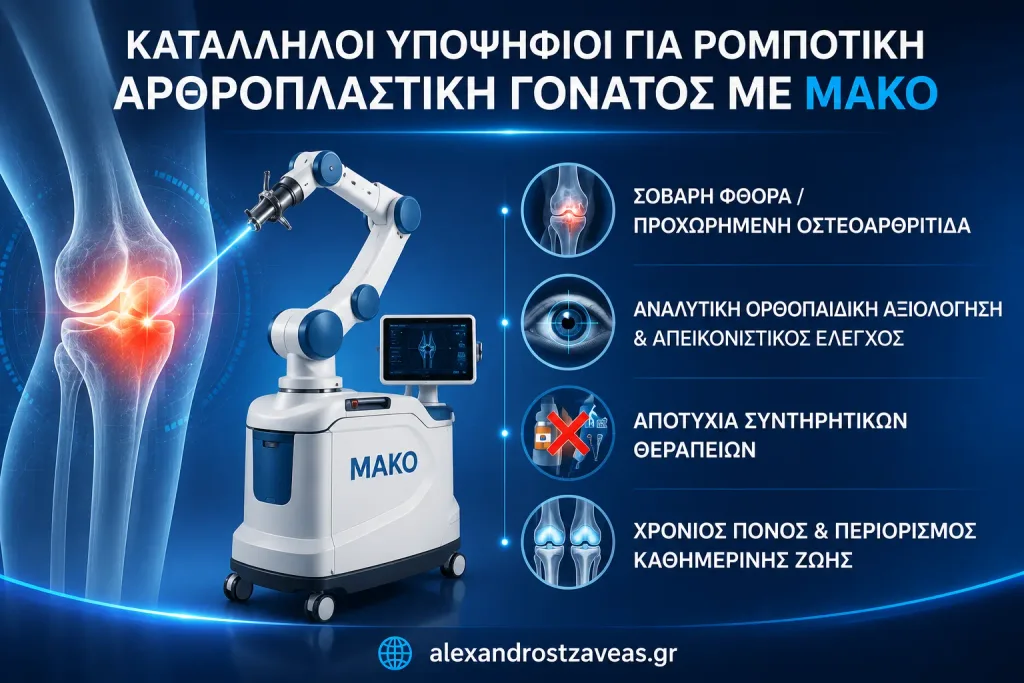

Suitable candidates for robotic knee arthroplasty with MAKO are patients who suffer from severe damage to the knee joint and have seen no improvement with conservative treatments. This method is intended for those who have advanced osteoarthritis, rheumatoid arthritis or post-traumatic arthritis, and also for cases of marked deformity of the knee and chronic pain that affects their daily life.
Not every patient, however, is automatically suitable for robotic knee arthroplasty with MAKO. The selection is made after a detailed orthopaedic assessment, imaging and an evaluation of general health. The aim is to establish whether arthroplasty is the right solution and whether robotic assistance can offer a real advantage in the particular case.
Suitable candidates for robotic knee arthroplasty
Suitable candidates for robotic knee arthroplasty with MAKO are usually patients who have severe damage to the knee joint and who no longer obtain meaningful improvement from non-surgical treatments.
The method may apply to patients with:
Advanced osteoarthritis of the knee
Rheumatoid arthritis that has severely affected the joint
Post-traumatic arthritis following an earlier injury
Marked deformity of the knee, such as varus or valgus
Chronic pain that does not subside with drug treatment
Considerable difficulty in walking and in everyday movement
Instability, or a feeling that the knee “gives way”
Restriction of activities because of pain and stiffness
The presence of these problems does not necessarily mean that the patient must have surgery immediately. It does mean, however, that a specialist assessment is needed, in order to establish whether arthroplasty is the appropriate solution and whether the MAKO system can help with more precise planning of the procedure.
The role of pain and function
A key criterion in selecting a patient is how far their everyday function is affected. The decision is not based on the radiograph alone. There are patients with considerable wear on imaging but relatively tolerable symptoms, just as there are patients with severe pain and serious restriction in daily life.
The orthopaedic surgeon assesses whether the pain affects walking, sleep, work, independence and overall quality of life. When the patient begins to avoid activities, to limit their movements or to need help more often, then surgical treatment may become a serious option.
The failure of conservative treatment also plays an important part. If drug treatment, physiotherapy, injections, weight loss, the use of walking aids or the modification of activities no longer offer meaningful relief, then the patient may be assessed for robotic knee arthroplasty with MAKO.
When a patient may not be suitable
Although robotic knee arthroplasty with MAKO offers significant advantages in selected cases, it is not suitable for everyone. There are conditions that may increase the risk of complications or that call for a different therapeutic approach.
Possible limiting factors are active infection, serious uncontrolled cardiac or respiratory problems, serious clotting disorders, very poor general health, or an inability to take part in the rehabilitation programme.
Some patients may also need better control first of accompanying conditions such as diabetes mellitus, hypertension or other problems that affect the safety of the procedure. In every case, the final decision must be taken on an individual basis.
What the orthopaedic surgeon examines before the decision
Before robotic knee arthroplasty with MAKO is proposed, the orthopaedic surgeon examines the patient's condition as a whole. Establishing that there is wear in the joint is not enough on its own. The symptoms, the mobility, the alignment of the knee, the medical history, the coexisting conditions and the patient's expectations all need to be assessed.
The preoperative work-up may include radiographs, special measurements of the alignment of the lower limb, blood tests, a cardiological assessment and an assessment by an anaesthetist. With these data the doctor can plan the procedure with greater precision and reduce the possible risks.
MAKO works as an assistive tool. It does not replace the surgeon and it does not carry out the procedure on its own. It is the doctor who assesses, decides, operates and guides the patient at every stage.
The doctor's role in selecting the right candidate
Selecting the right candidate for robotic knee arthroplasty with MAKO requires experience and sound clinical judgement. The technology can offer precision, but success depends to a great extent on the orthopaedic surgeon, on the assessment of the case and on correct planning.
Dr Tzaveas, with experience in modern arthroplasty techniques and in robotic assistance, can assess responsibly whether a patient is suitable for knee arthroplasty with MAKO. Through an individualised approach, detailed information and an organised treatment plan, the patient can know clearly what their options are and what they can expect from the procedure.
Conclusion
Suitable candidates for robotic knee arthroplasty with MAKO are usually patients with severe wear in the joint, severe pain, reduced mobility and failure of conservative treatments. The method can offer significant advantages in selected cases, particularly where precision is required in the planning and in the positioning of the implants.
Suitability, however, must always be assessed on an individual basis. The experience of the orthopaedic surgeon, correct diagnosis, preparation and postoperative rehabilitation are key factors for a safe and functional result.