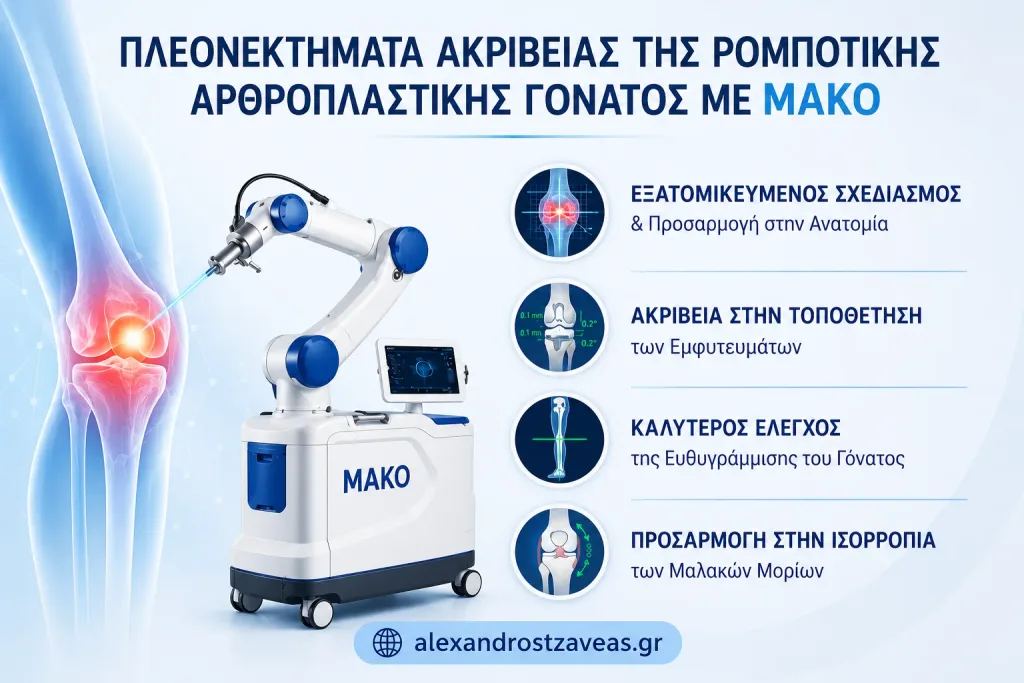

The precision advantages of MAKO robotic knee arthroplasty include improved alignment and accurate positioning of the implants, which is critical for the stability and function of the joint. The MAKO robotic system provides real-time data, allowing orthopaedic surgeons to perform these operations with greater precision and individualisation, tailoring the plan to the needs of each patient.
Precision advantages of MAKO robotic knee arthroplasty
MAKO robotic knee arthroplasty is a modern surgical approach that places particular emphasis on precision, individualised planning and better control of the operation. In knee arthroplasty, correct alignment of the limb and accurate positioning of the implants are decisive factors for the stability, the movement and the long-term function of the joint.
The MAKO robotic system does not replace the orthopaedic surgeon and does not carry out the operation on its own. It works as an advanced assistive tool that provides the surgeon with useful data on the patient’s anatomy, the alignment of the knee and the position of the implants. The surgeon always retains full control and uses the technology in order to perform the operation with greater precision.
Precision advantages of MAKO robotic knee arthroplasty: individualised planning for every patient
One of the main advantages of MAKO robotic knee arthroplasty is that the planning is tailored to the particular characteristics of each patient. Every knee has a different anatomy, a different degree of wear, a different alignment and different functional needs.
Before the operation, the orthopaedic surgeon assesses the condition of the joint, the wear, the stability, the range of movement and the alignment of the lower limb. With the help of the MAKO system, the surgical plan becomes more specific and is adapted to the patient’s actual data.
This matters, because knee arthroplasty should not be treated as one and the same procedure for everyone. The aim is for the implants to be positioned in a way that respects the unique anatomy and needs of each knee.
Precision in the positioning of the implants
Correct positioning of the implants is one of the most critical aspects of knee arthroplasty. Even small deviations can affect the way the knee feels, its stability, walking and overall function after the operation.
With MAKO robotic assistance, the orthopaedic surgeon can have better control of the position and the angle of the implants. The system provides real-time data and helps the surgeon to follow the surgical plan more consistently.
Greater precision in positioning may contribute to better knee mechanics, a more stable joint and a more natural sensation during movement, always depending on the individual patient’s case.
Better control of knee alignment
Alignment of the lower limb is very important in knee arthroplasty. When the knee has marked wear, varus or valgus deformity, the joint is not loaded correctly and the patient may experience pain, instability and difficulty walking.
The MAKO system helps the orthopaedic surgeon to check the alignment of the knee more precisely during the operation. This allows better adaptation of the implant and a more controlled restoration of the mechanics of the lower limb.
Proper control of alignment can be particularly important in patients with substantial deformity, advanced osteoarthritis or previous injuries that have affected the shape and the function of the knee.
Adjusting the balance of the soft tissues
In knee arthroplasty it is not only the position of the implants that matters, but also the balance of the soft tissues around the joint. The ligaments and the surrounding tissues affect the stability, the movement and the feel of the knee after the operation.
MAKO robotic assistance can help the surgeon to assess the behaviour of the joint more precisely during the operation. The surgeon can then adjust the surgical plan, where this is needed, so that the knee has better balance and stability.
This capability is important, because a well-positioned implant must work in harmony with the patient’s tissues and not simply sit in the correct place on an X-ray.
A more controlled surgical procedure
A further precision advantage of MAKO robotic knee arthroplasty is that the procedure becomes more controlled. The surgeon has more information available during the operation and can proceed on the basis of objective data.
This can help to reduce deviations from the original plan and to adapt the operation more closely to the needs of the patient. The technology offers guidance, but the final decision always rests with the orthopaedic surgeon.
A more controlled procedure can be particularly useful in complex cases, where the anatomy of the knee is not typical or where there is significant wear and deformity.
A possible contribution to a more predictable recovery
Precision in the planning and in the positioning of the implants may contribute to a more predictable postoperative course. When the knee has better alignment, stability and mechanical balance, the patient may be in a better position for safe mobilisation and functional rehabilitation.
This does not mean that all patients will have the same experience or the same recovery time. Rehabilitation depends on many factors, such as age, general health, muscle condition before surgery, the severity of the wear and consistency with the physiotherapy programme.
MAKO technology can offer considerable help at the surgical stage, but proper rehabilitation remains essential for the final result.
The role of the orthopaedic surgeon
Although the MAKO system offers significant precision advantages, the most decisive factor remains the orthopaedic surgeon. The technology is a tool in the surgeon’s hands. Correct diagnosis, selection of the appropriate patient, careful planning and experience in knee arthroplasty have a direct influence on the outcome.
Dr Tzaveas, with experience in modern arthroplasty techniques and in robotic assistance, assesses every case individually. MAKO technology is used as a means to greater precision and better control, while clinical judgement and surgical experience remain at the centre of the treatment process.
Conclusion
The precision advantages of MAKO robotic knee arthroplasty are linked to individualised planning, more accurate positioning of the implants, better control of alignment and a more controlled surgical procedure.
The method can offer significant benefits in selected patients, particularly where there is advanced wear, deformity or a need for greater precision. Success, however, does not depend on the robotic system alone. It depends on correct patient selection, the experience of the orthopaedic surgeon, careful preparation and an organised postoperative rehabilitation programme.

