
The hip joint is a ball-and-socket joint (Fig. 1) and consists of the femoral head (the ball), which articulates with the acetabulum (the socket). It plays an important part in bearing large loads, since the weight of the body is transferred to the lower limbs through it. At the same time it has remarkable stability, so that the legs can move safely in walking. The surfaces of the two bones (the femoral head and the acetabulum) that come into contact are called articular surfaces. So that one surface can glide smoothly over the other, they are covered with articular cartilage which has a low coefficient of friction. Articular cartilage is so smooth that it could be likened to glass or ice. It is no accident that in histological terms it is called hyaline cartilage. The movement of one surface over the other is thus like an ice skate gliding over ice.
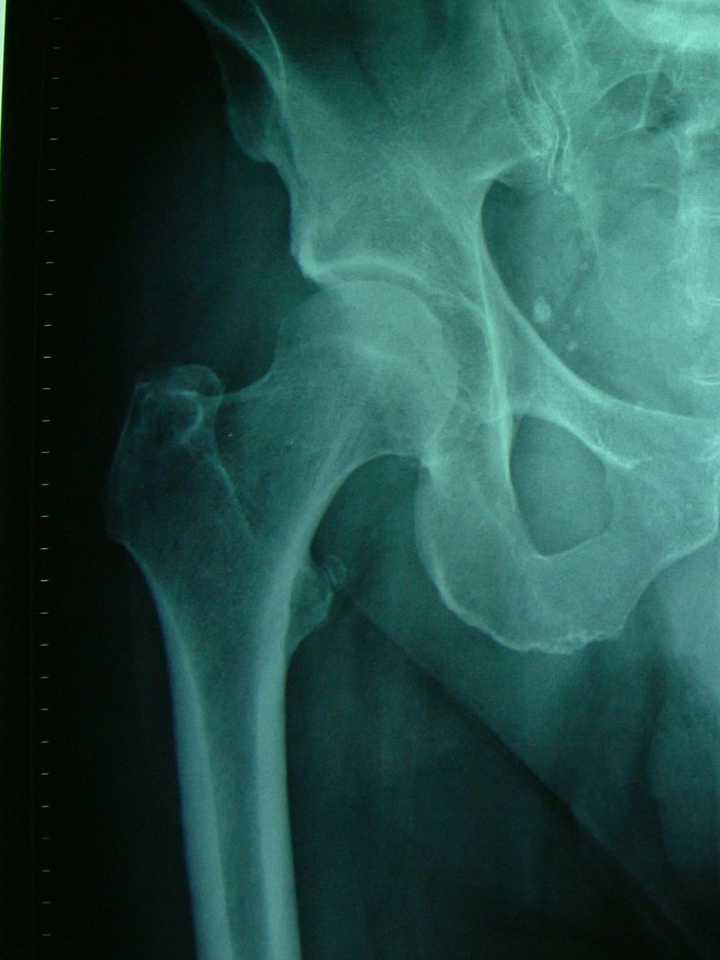
The pathological damage of osteoarthritis
Unfortunately the hip joint is one of the commonest sites for the development of osteoarthritis. Osteoarthritis means wear of the joint and it may be primary (idiopathic) when it is due to an unknown cause, or secondary, that is, the result of another pathological condition. In both cases the outcome is the same: the gradual destruction of the articular cartilage. If one were to look at osteoarthritic cartilage under magnification, one would see softening and fibrillation (fraying) of the cartilage in the early stages, while in advanced osteoarthritis one would see its destruction and its absence in places, leaving bare bone. These changes cause an increase in friction between the two bones at first, and then the formation of microfractures, that is, slight collapse of the areas stripped of articular cartilage. These lesions mark the beginning of a series of associated changes that take place within the joint itself and also in the neighbouring areas, and they are responsible for the sensation of pain and stiffness that the patient experiences.
Symptoms
Osteoarthritis, if it is primary, chiefly affects patients over the age of 50. When it is secondary, however, it also appears at younger ages, sometimes as early as the third decade of life. The main symptoms are pain and stiffness. The pain is usually felt in the groin (the root of the thigh), that is, at the front of the joint, and it may radiate as far as the knee. It appears mainly after periods of vigorous physical activity, and gradually becomes more and more frequent, even at rest. When the pain appears at night and wakes the patient from sleep, the osteoarthritis is usually advanced. Stiffness (difficulty in moving the joint) is first felt after long periods of rest. Later it increases progressively, sometimes reaching the point where the patient has difficulty putting on socks or shoes. In the early stages a limp may appear (the patient walks with a limp).
Diagnosis
The most important part of the diagnostic process is taking the history and the clinical examination by the orthopaedic surgeon. The orthopaedic surgeon needs to understand the degree of disability that the condition causes the patient, and whether the pain really does come from the hip joint or from some neighbouring area. In most cases a plain radiograph of the joint is enough to complete the diagnosis. In some patients, however, further investigation may be needed, in the form of blood tests, computed tomography and magnetic resonance imaging or a bone scan in order to exclude other conditions with similar symptoms.
Treatment – conservative measures
In the early stages of the disease the problems can be managed with simple conservative measures. The pain can be eased with simple analgesics, such as paracetamol, or with non-steroidal anti-inflammatory drugs, which are nevertheless best taken for a short period only. Dietary supplements, such as glucosamine or chondroitin, may relieve the symptoms, although they are not effective in every case. The use of a walking stick (cane), and also raising the sole of the shoe on the affected leg, improve walking. Physiotherapy is a means of relief of the greatest importance for the osteoarthritic patient. It offers not only strengthening of the muscles to protect the neighbouring joints but also relief from pain. The physiotherapist gives specific advice on posture and appropriate exercises aimed at reducing stiffness and improving the general condition of the body. Relief from pain is also offered by such modalities as laser, ultrasound and diathermy, while significant results have been seen with the use of transcutaneous electrical nerve stimulation (tens). In recent years various forms of alternative medicine have also been developed, with inconsistent results. These include acupuncture, aromatherapy, reflexology, chiropractic and osteopathy.
Treatment – intra-articular injections
The intra-articular injection (injection of a drug into the joint) is an important weapon in the orthopaedic surgeon's armoury for relieving the patient's symptoms. Intra-articular injections fall into two categories. The first category comprises injections of a mixture of local anaesthetic and steroid. The local anaesthetic gives immediate relief of the symptoms, while the steroid gives a longer-term reduction in the inflammation in the joint that results from the arthritis. The second category comprises injections of an artificial joint fluid, a substance called hyaluronic acid. Hyaluronic acid is a substance found in the normal joint and it has a dual role: it acts as a lubricant in the joint, being a fairly viscous substance, and it also has a beneficial effect on the articular cartilage. The results are quite encouraging as regards the reduction of stiffness and the reduction of pain in patients. In recent years great emphasis has been placed on the use of components of the patient's own body which potentially have a regenerative effect on the joint. These are biologic agents and cells. The growth factors are obtained by a simple blood sample from the patient's peripheral blood and, after simple processing, are injected into the joint. The cells may come from several sources, but bone marrow has recently been favoured as the better donor site, as it contains both a large quantity of cells and cells of better quality. These are multipotent, primitive cells which can be turned into cells of many different tissues. Under the right conditions, if the cells are introduced into a joint with cartilage lesions, they can turn into cartilage cells which will fill in the defects in the cartilage.
Treatment – surgical techniques
Hip arthroscopy
Hip arthroscopy has developed greatly in recent years and holds an important place in hip surgery. Arthroscopy is indicated in early-stage hip osteoarthritis, that is, when it is first diagnosed. With this method it is possible to carry out a “clean-up” of the joint (debridement), removal of the loose bodies, removal of any osteophytes and smoothing of structures that have lost their original shape. Arthroscopy does not, of course, cure the arthritis, but it reduces the severity of the symptoms and delays the arrival of the stage at which the hip will need a more “aggressive” operation.
Hip arthroplasty
Total hip arthroplasty is perhaps the most successful operation in the history of orthopaedics, as it offers immediate relief from pain and rapid mobilisation of the patient from the first postoperative day. The technique involves replacing the hip joint with an artificial joint. In essence, the femoral head and the surface of the acetabulum are replaced with metal implants (Fig. 2). It is one of the major orthopaedic operations; nevertheless, with the improvement of surgical techniques, of orthopaedic materials and of postoperative protocols, immediate mobilisation of the patient has been achieved, the hospital stay has been kept to a minimum, and the patient is able to walk with axillary crutches the day after the operation. Whatever the approach (anterior, posterior or lateral) and the size of the incision, total hip arthroplasty has shown excellent results and high patient satisfaction. Detailed information given to the patient by the surgeon is a prerequisite before proceeding to this operation.
Variants of total hip arthroplasty
Resurfacing arthroplasty is a variant of the classical total hip arthroplasty, designed for younger patients with greater demands. In this technique only the surface of the femoral head is replaced, and not its whole mass (Fig. 3). Much more bone stock is preserved in this way, while the artificial head that is inserted has roughly the same diameter as the original, so that the likelihood of dislocation ( the accidental exit of the artificial head from the acetabulum), which is the commonest complication of total hip arthroplasty, tends to be nil. With this arthroplasty the patient is able to carry out most, if not all, of the physical activities that a person with a normal hip performs. mini total hip arthroplasty is another variant of the classical total arthroplasty, in which smaller implants are used on the femoral side (the lower part of the joint). The rationale of this operation is that more bone is preserved in the area, thereby disturbing the local anatomy less. The technique is, however, still under study internationally.
Other techniques
Other surgical techniques have been used in the past which are either outdated today or the subject of scientific controversy. There are also promising techniques which are at present at an experimental stage with still limited clinical application. Osteotomy is a technique in which the axis of the femur or the orientation of the acetabulum is altered. It is applicable in young patients with anatomical abnormalities of the hip. Today it is used in strictly selected patients. Articular cartilage transplantation is the replacement of cartilage defects with grafts and is used in limited chondral lesions.

