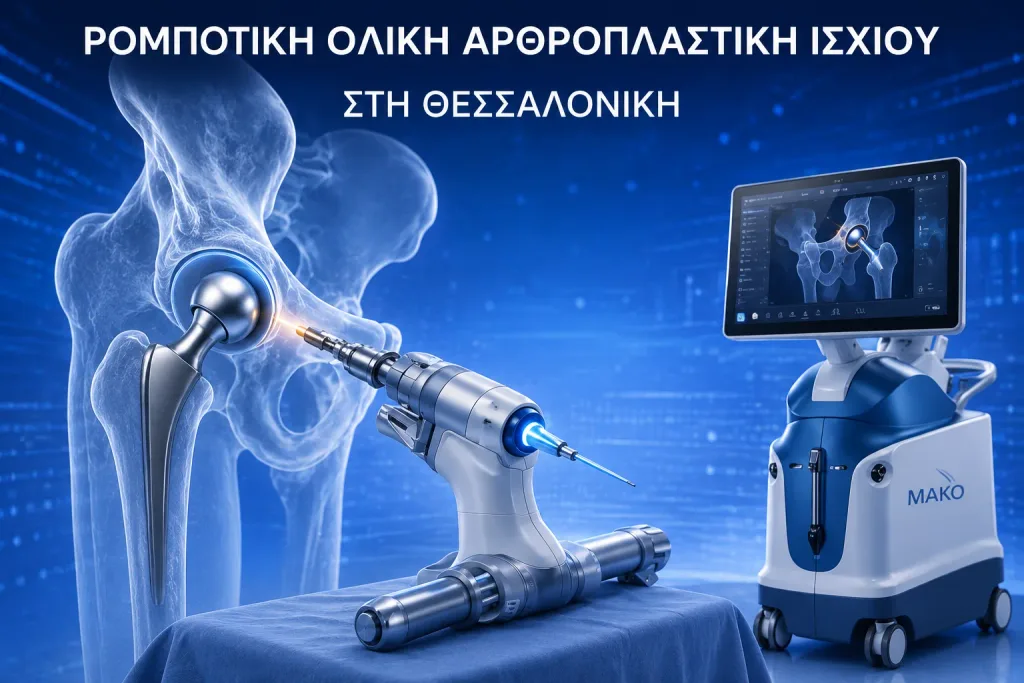

MAKO Robotic Total Hip Arthroplasty in Thessaloniki offers an advanced solution for patients with hip problems, ensuring accuracy in the positioning of the implant and improved recovery. The procedure requires detailed preoperative assessment and specialist surgical guidance, and strict safety protocols are followed. The operation is carried out only after a thorough clinical assessment and investigations, and in accordance with all the requirements for inpatient care, surgical protocols and patient information set out in Greek law. What is robotic total hip arthroplasty in Thessaloniki?
Robotic total hip arthroplasty in Thessaloniki is an advanced surgical technique for replacing the hip joint, in which specialist robotic systems such as MAKO are used to assist the surgeon. Robotic support allows the orthopaedic surgeon to plan the positioning of the implant precisely, taking into account the individual anatomical characteristics of each patient. This increases accuracy during the operation and reduces the risks associated with incorrect positioning.
Unlike conventional total hip arthroplasty, robotic systems make use of three-dimensional imaging software and digital preoperative planning, allowing the bony anatomy to be assessed, alignment to be optimised and the positioning of the implant to be adjusted in real time. The procedure involves less damage to the surrounding tissues and usually less blood loss during the operation. Many patients report a faster recovery and a shorter hospital stay after robotic surgery.
Robotic total arthroplasty is carried out in specialist centres in the city and by specialist orthopaedic surgeons with experience in robotic surgery. It offers patients an increased sense of safety and predictability as to the final result. These procedures follow international protocols, and MAKO technology has been approved by international bodies, as set out by the FDA.
Robotic technology:
Supports greater accuracy in the positioning of the implant.
Offers individualised preoperative imaging for a better fit.
Faster postoperative mobilisation and recovery.
A smaller incision compared with the conventional method.
Which patients are suitable for robotic total hip arthroplasty?
The selection of the right patient depends on a number of factors, including general state of health, the type and severity of the damage to the hip, and the anatomical requirements of each individual. Ideal candidates for the method are considered to be those suffering from severe osteoarthritis or other degenerative conditions of the hip that cause persistent pain and significant restriction of everyday life. The operation usually applies to people who have not responded satisfactorily to conservative or drug treatments.
The robotic method is indicated mainly in patients seeking greater accuracy in the positioning of the implant, so as to reduce the risk of injury or early failure of the operation. In addition, people with deformities, unusual features or anatomical variations of the hip may benefit, since preoperative planning through the robot allows thorough adjustment. The method is also suitable for younger patients who wish to return to a more active daily life.
Every patient undergoes a detailed assessment by an orthopaedic surgeon, and specialist investigations such as MRI or CT are carried out before the operation is decided upon. The final decision is taken on the basis of the clinical picture and the personal goals of the patient as regards mobility and quality of life.
What are the indications and contraindications for the operation?
The main indications for robotic total hip arthroplasty are advanced osteoarthritis, post-traumatic arthritis and disorders such as rheumatoid arthritis, which cause severe pain, stiffness and serious loss of function of the joint. People whose quality of life is significantly impaired by pain and restricted movement are classic candidates for the operation. It is also indicated in patients in whom conservative measures such as physiotherapy, drug treatment or intra-articular injections with agents such as hyaluronic acid have failed.
Contraindications include active infection, severe osteoporosis, uncontrolled diabetes mellitus, bleeding problems or significant cardiorespiratory disease, which increase the surgical risk. Patients with severe psychiatric disorders or an inability to cooperate also find it difficult to comply with the postoperative protocol and may not be considered suitable. Detailed preoperative assessment is essential in order to minimise risk.
All decisions are taken in collaboration with a specialist orthopaedic surgeon and the other medical specialties involved, with the aim of safeguarding safety and effectiveness. It is important that patients are informed in detail about the possible benefits and the limitations of the procedure, in line with the guidelines provided by international bodies such as the NHS.
Active infection is an absolute contraindication to the operation.
Severe osteoarthritis is considered a principal indication.
Uncontrolled diabetes counts against the operation.
Cooperative patients have a better prognosis.
Previous failure of conservative methods is taken into account.
How do I prepare before robotic total hip arthroplasty?
Preparation before robotic total hip arthroplasty begins with a thorough medical assessment, which includes a review of the medical history, laboratory tests and specialist imaging such as CT or MRI in order to create a digital three-dimensional model. The surgeon reviews all the parameters in order to plan the positioning of the implant precisely, tailored to the needs of the patient. Discussing any medication being taken with the doctor is considered essential.
Stopping substances that affect blood clotting, such as anticoagulants and non-steroidal anti-inflammatory drugs, is often recommended, on the instructions of the orthopaedic surgeon or the anaesthetist. Patients with coexisting conditions such as diabetes or hypertension must ensure that their condition is optimally controlled before the operation. Physical preparation is also considered important, and it is advisable to strengthen the muscles around the hip in readiness for rehabilitation.
Informing the patient about the course of the operation, the expected recovery and any complications helps to reduce preoperative anxiety and improves cooperation during the hospital stay. It is advisable to organise the practical details of the postoperative period in good time, such as help at home or transport, so that recovery proceeds smoothly.
I find out about all the preoperative steps and investigations.
I discuss stopping medication with my doctor.
I look after my diet and my physical condition.
I ask about possible complications and the measures to prevent them.
I arrange postoperative help at home.
What are the main stages of robotic total hip arthroplasty?
Robotic total hip arthroplasty involves specific stages that guarantee the greatest possible accuracy and safety for the patient. The first stage is detailed preoperative planning, in which a full digital model of the hip is created with the help of three-dimensional imaging. The surgeon determines the ideal position and size of the implant, taking into account the unique anatomy of each individual.
During the operation, the robotic system helps the surgeon to carry out the procedure with millimetre accuracy, in accordance with the plan. The robot provides immediate tracking feedback and limits deviations from the plan, resulting in precise alignment and stability of the implant. This minimises risks such as displacement or loosening.
After the implant has been positioned and joint function checked, the incision is closed carefully so as to achieve rapid healing. The total operating time varies according to complexity, while a shorter hospital stay is often required compared with the conventional method. MAKO technology is designed to ensure effectiveness at every step.
Individualised implant planning with three-dimensional analysis based on a 3D CT scan.
Robotic guidance in the preparation of the bone.
Immediate checking of implant alignment.
Careful closure of the incision for better healing.
Continuous monitoring of vital signs throughout.
What are the risks and what can we expect from the operation?
Every surgical operation carries a risk of complications, although with the use of robotic technology these tend to be less frequent and less severe. The main complications are infection, embolism, venous thrombosis, bleeding or nerve irritation. The surgeon takes all the necessary preventive measures, such as giving antibiotics, using specific antithrombotic agents and strictly following hygiene protocols.
The advantages of robotic total hip arthroplasty include high accuracy in the positioning of the implant, which reduces the risk of failure and increases the lifespan of the implant. Most patients can expect improved mobility, reduced pain and a rapid return to everyday activities. The rate at which repeat surgery is needed is lower than with standard methods, provided the appropriate rehabilitation instructions are followed.
Despite the advantages, it is important that the patient is informed about all the possible risks and that achieving the best result depends both on cooperation and on factors such as age, coexisting conditions and adherence to instructions. Data from international studies, such as those of the American Academy of Orthopaedic Surgeons, confirm long-term benefits and lower complication rates with robotic techniques.
There is a possibility of postoperative infection or thrombosis; however, every measure is taken so that this possibility is very small indeed.
Swelling and bruising are common, but they settle.
The return to heavy activity is gradual.
Rarely, dislocation or lengthening of the limb may occur.
Keeping in touch with the doctor is essential if symptoms occur.
How does rehabilitation work after robotic total hip arthroplasty?
Rehabilitation after robotic total hip arthroplasty is structured so as to promote a safe and rapid return of the patient to everyday life. Mobilisation usually begins on the same or the following day after the operation, under the guidance of physiotherapists. The aim is to improve balance, strengthen the muscles and gradually restore the function of the joint.
During the first few weeks, the emphasis is on avoiding movements that could put the implant at risk of dislocation or displacement. Physiotherapy is tailored to individual needs and it is recommended that the instructions be followed closely, so that complications are minimised and the best result is achieved. Most patients can walk without crutches in 4-6 weeks, while full rehabilitation is usually completed within 3 months.
Diet, wound care and adherence to the drug treatment protocol are critical to achieving safe healing. Regular follow-up appointments with the orthopaedic surgeon are essential in order to monitor progress and deal promptly with any problem.
I carry out my doctor’s physiotherapy instructions every day.
I avoid rotational and extreme movements of the hip.
I keep the incision clean and protected.
I give up the crutches gradually, according to my progress.
I contact the doctor immediately if pain or swelling appears.
Case study: A 65-year-old patient with advanced arthritis returned to everyday activities within two months of robotic hip arthroplasty, following an individualised rehabilitation protocol.
What is the legal framework and what are the requirements in Greece for the procedure?
Robotic total hip arthroplasty is carried out in Greece under a strict legal and regulatory framework, safeguarding the rights and the safety of patients. The procedure is permitted only in hospitals and private clinics that hold specific authorisation and meet the operating standards of the Ministry of Health and of EOPYY. Doctors who perform operations with robotic systems must be certified in robotic surgery and must have taken part in continuing education.
The materials used and the robotic systems – such as MAKO – must be certified by international regulatory bodies (for example the CE Mark in the European Union and the FDA in the USA), while the choice of each implant is made on the basis of international safety guidelines. Monitoring effectiveness and reporting adverse events is part of the institutional framework, while the personal data of the patient is strictly protected under the legislation in force (Ministry of Health).
Patients receive an informed consent form before the operation, setting out the steps of the procedure, the possible risks and the alternative treatment options. It is important that they are informed about the «legal framework» so that they feel confident about their rights and know the procedures for reporting and for making a claim in the event of complications.
I check whether the clinic holds the required operating licences.
I ask whether the doctor has specialised in robotic hip surgery.
I ask for an informed consent document before the operation.
I find out about my rights and about data protection.
I enquire about the certification of the implant and of the MAKO system.
FAQs
Question: Who is responsible for patient safety in robotic hip surgery?
Answer: Responsibility lies with the specialist surgeon and the clinic that applies the regulatory protocols.
Question: Is informed consent compulsory for robotic hip arthroplasty?
Answer: Yes, the consent form is a requirement for every surgical procedure in Greece.
Question: Are these operations covered by insurance providers?
Answer: Some specialist procedures may be covered by public or private insurance organisations, in accordance with their policy.
Conclusion & next steps
The use of robotic technology in total hip arthroplasty offers greater accuracy and safety for patients who need surgical treatment. If you live in Thessaloniki and are experiencing problems with your hip, ask for a medical assessment by a specialist orthopaedic surgeon to discuss whether this method is suitable for you. Keep an eye on your symptoms and see a doctor promptly if severe pain, swelling or fever appears after an operation, always in accordance with the instructions of your treating doctor.
Gather your medical investigations and history of injuries
Discuss the available surgical protocols with your treating doctor
Find out about the requirements for preoperative and postoperative care

