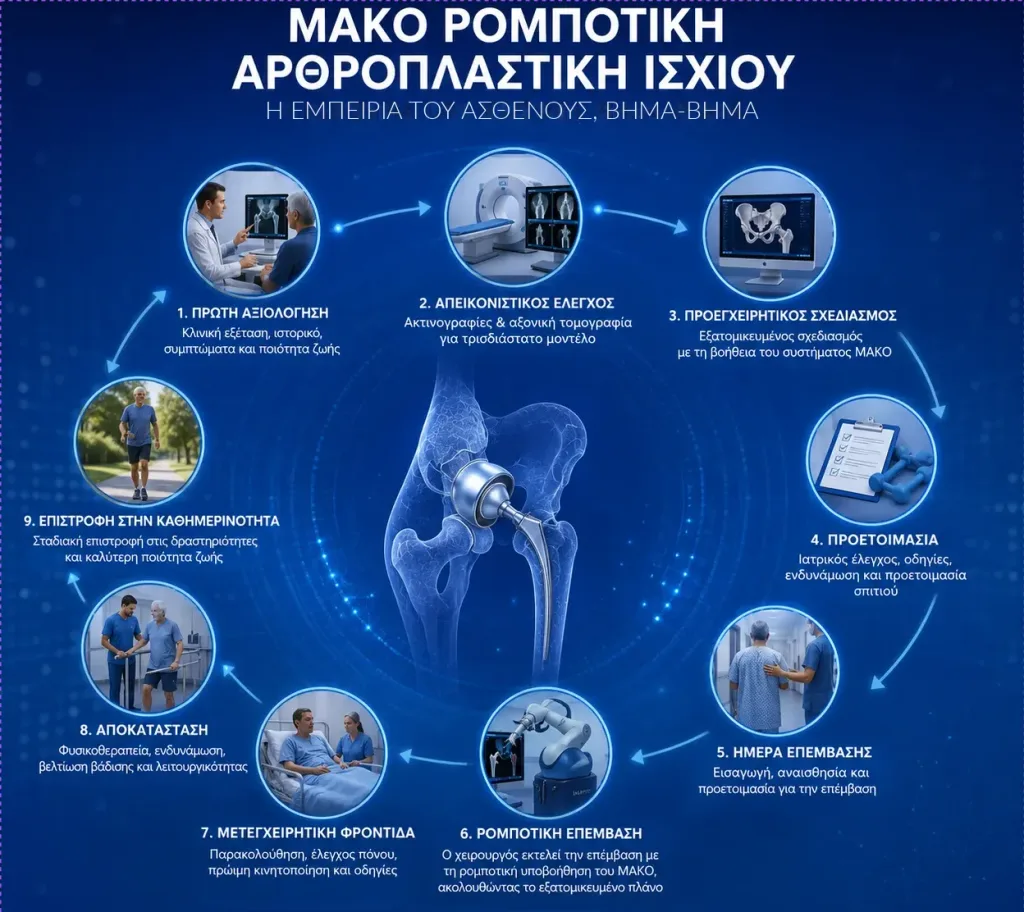

MAKO robotic hip arthroplasty is not only a matter of the technology used in the operating theatre. It concerns the patient's experience as a whole, from the first orthopaedic assessment through to preparation, surgery, mobilisation and the return to everyday life. For many patients, the decision to undergo hip arthroplasty is accompanied by anxiety, questions and a fear of surgery. Being properly informed helps the patient to know what to expect at each stage.
The MAKO robotic system allows the orthopaedic surgeon to plan the operation around the anatomy of each individual patient. With the help of three-dimensional imaging and robotic assistance, the surgeon can plan the position of the implants with greater precision. MAKO does not replace the surgeon and does not carry out the operation on its own. Rather, it acts as an advanced tool that helps the specialist surgeon to apply the surgical plan with greater control.
MAKO Robotic Hip Arthroplasty: Before the operation
The patient's experience begins before the operation. The first stage involves a detailed clinical examination, a full medical history and an assessment of the symptoms. The patient describes the pain, the difficulty in walking, the restriction of everyday movement and the way in which the hip condition affects their quality of life.
The orthopaedic surgeon may then request imaging, such as radiographs and a CT scan, so that the condition of the joint can be assessed accurately. In MAKO robotic hip arthroplasty, the CT scan is used to create an individualised three-dimensional model of the joint.
This stage is important, because the patient understands that the operation is not performed in a generic way but is planned around their own anatomical data. At the same time, the surgeon explains the possible benefits, the limitations, the risks and what can realistically be expected after the operation.
Preparing the patient
Before MAKO robotic hip arthroplasty, the patient needs to follow specific instructions. These may concern medication, the anaesthetic assessment, blood tests and general physical preparation.
In some cases the surgeon may recommend preoperative physiotherapy or gentle strengthening exercises, where this is feasible. Better muscle condition before surgery can help towards a smoother rehabilitation afterwards.
Practical preparation of the home is also important. It is advisable for the patient to make sure that the space they will return to after the operation is safe and easy to manage. Removing obstacles, placing everyday items within easy reach and having the support of a relative or friend during the first few days can make recovery considerably easier.
On the day of the operation
On the day of the operation the patient is admitted to hospital and the necessary preoperative steps are carried out. The medical team checks the patient's details, the investigations and the surgical plan. The anaesthetist explains the anaesthetic to the patient and answers any questions.
During MAKO robotic hip arthroplasty the orthopaedic surgeon uses the robotic system as a guidance tool. The surgeon performs the operation, while MAKO helps him to follow precisely the individualised plan drawn up before surgery.
For the patient, this means that the operation is based on careful planning and on individualised data relating to their own joint. Precision in the positioning of the implants can contribute to the stability, the function and the correct mechanics of the hip.
After the operation
After surgery the patient is taken to the recovery area and then to the ward. The medical team monitors the vital signs, such as blood pressure, together with pain, mobility, the surgical wound and the patient's general condition.
Early mobilisation is a key element of modern hip arthroplasty. Depending on the case and on the surgeon's instructions, the patient may begin to stand and walk with assistance relatively soon after the operation. Mobilisation is gradual, safe and supervised.
Pain after surgery is to be expected, but is usually controlled with appropriate medication. The patient is given instructions on the prevention of blood clots, care of the wound, the use of walking aids and the movements to be avoided during the first days or weeks.
Rehabilitation and the return to everyday life
Rehabilitation is an important part of the patient's experience. The success of MAKO robotic hip arthroplasty depends not only on the technical precision of the operation but also on a well-managed postoperative course.
The patient follows a physiotherapy programme aimed at improving walking, strengthening the muscles and returning safely to everyday activities. Progress differs from person to person and depends on age, general health, muscle condition before surgery and how consistently the rehabilitation programme is followed.
Gradually, the patient can return to simple everyday movements such as walking around the house, using the stairs and personal care, and later to work or more active pursuits, always in accordance with the surgeon's instructions.
The doctor's role in the patient's experience
The patient's experience of MAKO robotic hip arthroplasty is influenced to a great extent by the experience, the specialist training and the guidance of the orthopaedic surgeon. Although MAKO technology offers high precision in planning and robotic assistance, it is the surgeon who assesses the patient, takes the decisions, performs the operation and directs the postoperative course.
The patient needs to feel that there is a doctor beside them who can explain in simple and understandable terms what is going to happen, what the possible benefits are, what the limitations are and what to expect after the operation. Good communication reduces anxiety, builds confidence and helps the patient to take a more active part in their own rehabilitation.
Dr Tzaveas, with experience in modern arthroplasty techniques and in MAKO robotic assistance, places the emphasis on an individualised assessment of every case. From the first consultation through to preoperative planning, the operation and postoperative follow-up, the aim is for the patient to have clear information, an organised plan and safe guidance at every stage.
Conclusion
The patient's experience of MAKO robotic hip arthroplasty is a complete process that begins with the diagnosis and continues until the return to everyday life. MAKO technology offers the surgeon the ability to plan precisely and to operate with robotic assistance, while the patient benefits from a more individualised and better organised approach to treatment.
The experience of the orthopaedic surgeon plays a decisive role. Drawing on his knowledge of modern arthroplasty techniques and of MAKO robotic surgery, Dr Tzaveas can guide the patient responsibly, from the initial assessment through to rehabilitation. Clear information, careful preparation and continuous medical follow-up all contribute to a safer and more functional postoperative course.

