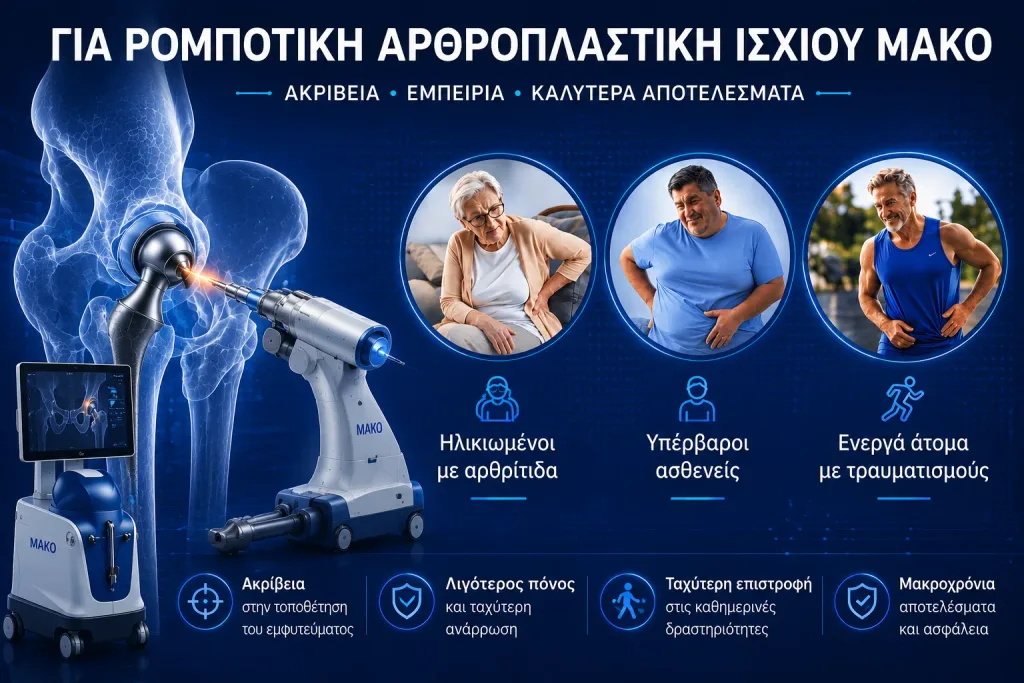

The suitable candidates for MAKO Robotic Hip Arthroplasty are patients with severe damage to the hip joint who have not responded to conservative treatments. The MAKO robotic method offers greater accuracy in the positioning of the implants, improving the function of the joint and the patients' quality of life. The method is chosen after a detailed orthopaedic assessment and an evaluation of the patient's general health.
Not every patient, however, is automatically suitable for MAKO robotic hip arthroplasty. The final decision is always taken after a full orthopaedic assessment, imaging investigations and an evaluation of the patient's general state of health. The aim is not simply to use an advanced technology, but to apply the right treatment to the right patient, safely and with realistic expectations.
Suitable Candidates for Robotic Hip Arthroplasty
Suitable candidates for MAKO robotic hip arthroplasty are usually patients who have severe damage to the hip joint and no longer gain any real improvement from non-surgical treatments.
The method may be appropriate for patients with:
Advanced hip osteoarthritis
Rheumatoid arthritis that has severely affected the joint
Post-traumatic arthritis after an earlier injury
Avascular necrosis of the femoral head
Congenital or anatomical particularities of the hip
Chronic pain that does not settle with medication
Significant difficulty in walking and in everyday movement
The presence of these problems does not necessarily mean that the patient must be operated on immediately. It does mean, however, that a specialist assessment is needed in order to establish whether arthroplasty is the appropriate solution and whether MAKO robotic assistance can offer a real advantage in the particular case.
The role of pain and function
A basic criterion in selecting a patient is how far everyday function is affected. The decision is not based on the radiograph alone. There are patients with marked radiological findings but relatively tolerable symptoms, just as there are patients with significant pain and severe limitation in everyday life.
The orthopaedic surgeon assesses whether the pain affects walking, sleep, work, independence and overall quality of life. When the patient begins to avoid activities, to move about less or to depend more and more on help, surgical treatment may become a serious option.
Failure of conservative treatment also plays an important part. If medication, physiotherapy, weight loss, the use of walking aids or modification of activities no longer provide relief, the patient may be assessed for MAKO robotic hip arthroplasty.
When a patient may not be suitable
Although MAKO robotic hip arthroplasty offers significant advantages in selected cases, it is not suitable for everyone. There are conditions that may increase the risk of complications or call for a different therapeutic approach.
Possible limiting factors are active infection, serious uncontrolled cardiac or respiratory problems, serious disorders of blood clotting, advanced osteoporosis, poor general health or an inability to take part in the rehabilitation programme.
In such cases the doctor may ask for further investigations, for the control of co-existing conditions or for a different treatment plan. The patient's safety always comes before the choice of technology.
What the orthopaedic surgeon examines before the decision
Before MAKO robotic hip arthroplasty is proposed, the orthopaedic surgeon examines the patient's condition as a whole. Establishing that there is wear in the joint is not enough on its own. The symptoms, the mobility, the medical history, the co-existing conditions, the patient's expectations and the possibility of safe rehabilitation all have to be assessed.
The preoperative work-up may include radiographs, a CT scan for the three-dimensional MAKO planning, blood tests, cardiological assessment and review by an anaesthetist. In this way the doctor can plan the operation precisely and reduce the possible risks.
Conclusion
The suitable candidates for MAKO robotic hip arthroplasty are usually patients with severe wear in the joint, marked pain, reduced mobility and failure of conservative treatments. The MAKO method can offer significant benefits in selected cases, but suitability must always be assessed on an individual basis.
In this process the experience of the orthopaedic surgeon plays a decisive part. The specialist doctor does not look only at the radiological picture or at the technology, but assesses the patient as a whole, along with their needs, their history and their expectations. Dr Tzaveas, with experience in modern arthroplasty techniques and in MAKO robotic assistance, can guide the patient responsibly, explain the options available and propose the appropriate treatment plan with the aim of reducing pain, improving mobility and allowing a safe return to everyday life.

